Saturday, November 19, 2016

Giving Thanks

The bio I include with prints for people who buy my photography poses this question: How many ways are there to give thanks, to give honor? Giving Thanks gets a formal nod this coming week, with gatherings of family and friends. Some will recall earlier holidays when more chairs rounded the table. It can be difficult to muster gratitude when grief seems to have the louder, more insistent voice.


One way I overcame my own soul's season of sorrow years ago was to stretch the practice of gratitude far beyond the fourth Thursday in November. A daily journaling practice of writing ten small somethings I was grateful for, every day, reawakened my senses to all the good and joyous and beautiful in the world that was only waiting for me to notice, and give a nod of recognition.

Photography, mindful photography, has become for me a kind of walking meditation, a practice that attempts to answer the question of my bio: one way, the photographer's way, is to be deliberately present. I tell my photography students, notice what you notice. What catches not only your eye, but your breath?

Increasingly I am drawn to expansive scenes that evoke the emotions of serenity, peacefulness, calm and receptivity.  For many, me included, giving thanks is an act of reverence, of worship. 

How do you give thanks? What seemingly small somethings would make a daily gratitude list for you?

Here are a few of mine, gleaned from the past couple of weeks:

I am grateful that the torn disc in my lower back is healing slowly and that I can once again drive and walk and photograph at a gentle pace.

I am grateful for the play of waning light on still water.

I am grateful that our little cove in Duck is beginning to fill with late autumn arrivals. 

I am grateful to once again have the chance to teach Mindful Nature Photography at After Dark, a community outreach program of winter evening classes offered at All Saints Episcopal Church. (Fees collected for the classes, which are given by volunteers, are donated in entirety to local charities such as our food bank, an outreach for which I am also grateful.)

Here are those same thoughts, expressed visually:


Thursday, November 10, 2016

The last couple of days have dawned overcast. When I start to spend many days in a row inside, one of the ways I invite beauty into my world is to look through past portfolios. Sometimes I find a treasure I had overlooked previously. Pete and I are hoping to take a winter interlude and travel to Florida for some R&R which for me includes bird photography. This afternoon I browsed through some folders from our last trip two years ago. Here are a few favorites from late afternoon, at Sanibel's Ding Darling NWR that I rediscovered this afternoon.


This Snowy Egret was much more intent on lunch than on me. Florida's birds are much tamer around humans than their North Carolina counterparts are. I was using a long lens here.


I find such humor sometimes in the natural world. I named this Grand Exit. 


Roseate Spoonbills are a darling of the Ding Darling refuge.


This was the first time we had actually stayed on Sanibel Island, so we could be in the Refuge for sunset. The color intensified after the sun slipped behind the trees.


Eventually there were hundreds of wading birds that flew in at dusk. I enjoyed the challenge of finding small groups for pleasing compositions.


Preparing to leave the refuge near closing time, I could make a last series of images 
showing the scale and grandeur of the scene as a whole.

Tuesday, November 8, 2016

Recordation or Revelation?

I began my career back in 1980 as a journalist. Living on the coast, that role meant documenting storm damage when it occurred as well as covering key events in our growing community. I believe the role of journalist is a crucial one, but I have exchanged that identity for someone who needs beauty. If I cannot easily see it, I need to sculpt it out of light and shadow, feathers and fur.

The poet Keats used "truth" and "beauty" synonymously. In my emotional and photographic lexicon, beauty is etymologic cousin to hope, to serenity, and to joy. Beyond picture postcards, images of beauty evoke in me an emotional response of purpose, of possibility, of abundance, and of connection. These are the photographs I seek, the visual love letters worth a thousand words.

I recently climbed Jockey's Ridge, the highest sand dune east of the Mississippi, what passes for elevation in these coastal flatlands. I thought I was headed out to photograph "Jockey's Lake" -- a rain-filled depression that currently holds more water than I have ever seen there, thanks to record rainfall between storms Hermine and Matthew. I was on the lookout for itsy-bitsy frogs, no bigger than my fingernail, that emerge in wet spells. I made passable images, overlapping panoramic documentary photos of the lake. I saw no frogs. Instead, what intrigued me was the play of fire on sand in the waning light of the afternoon -- the same visual metaphor that caught my heart and eye on a recent visit to a fishing pier here.  

What is beauty to you? What do you seek? Good questions, and not merely for photographers.


                                       I see the dance of flame, here, the kiss of sun on earth.


How often have I asked for my path, my way, to be illuminated?


Recordation or revelation? What do I see? What do I feel?

Wednesday, March 30, 2016

Q: What in the world is a Loon doing, trying to walk beside the bike path along Duck Road in Southern Shores?!?

A: Nothing that will result in its survival!

Loons, like gannets, are marvelously engineered for a life on the water, but their legs and feet are set too far back to allow them to successfully take off in flight from dry land. They need water not only to feed but also to get airborne.

I passed by the bird which was sort of dragging itself forward at about 6:25 pm and realized as I drove by what I had seen. Or to be more accurate, I questioned what I had just seen, so I quickly found a place to turn around and double check. Sure enough, the bird was a loon and in obvious distress. Hold on, I said out loud, as I drove past the second time. I’m coming to get you.

Cars were whizzing by but the bird at that moment was very near the fork in Southern Shores where the road splits and where there is a small parking area. I turned there and parked, my mind already trying to visualize what was in the back of the car that I could use. Normally I carry at least one towel for critter rescue, but my vehicle has been full of boxes transporting inventory and supplies between SeaDragon Gallery, our new gallery in Duck, and Yellowhouse Gallery in Nags Head. I’d removed a lot of the paraphernalia I keep in the car “just in case.” Well, here was a case. Now what?


I did have a thin waterproof pullover. It would have to do. Years ago, artist friend E.M. Corsa and I rescued a Northern Gannet, so I know the general drill: try to get close enough without spooking the bird in order to place a towel (read, pullover) over its head and gently scoop it up in a way that doesn’t hurt either the bird’s wings or you. I had never tried this alone.  As I was getting out of my car, a jogger passed by but the bird had frozen its motion and tucked its head down. I don’t think the jogger even noticed. I approached slowly and talked softly as I knelt down nearby. I hoped my calm outer demeanor would keep the bird calm. It eyed me but didn’t try to move. I called my friend for reassurance and covered the bird, carrying it gently in my arms back toward my car.  A couple of drivers figured out I was carrying something that needed help and stopped to let me cross. I put the loon on the floor of the passenger seat (my friend’s advice) – and it looked up at me and gave its haunting, trilling call.  I’ve never heard that call in person before, and I took it as a sign I was doing the right thing.


I drove back north to the Duck Boardwalk.  Near our shop is a set of stairs that leads right to the water. Alas, the gate at the top of the stairs was locked!! By this time, the loon was trying to move inside the pullover and straining its head back and forth. Did it sense the water? Was it alert to the smells and sounds of the Canada Geese nearby? I tucked it even closer to my body with my left hand and stroked its head with my right, crooning to it all the while. There was a dock facing west just a little way down the boardwalk. Off we went.

When I reached the dock, the closest pier to the water’s surface was still about a foot or foot and a half above it.  I took a deep breath, unwrapped the loon, and gently let it go as close to the water as I could. It dropped with a big splash but came right back up to the surface and immediately began swimming around past the dock and out into more open water, ducking its head under the water, rising and stretching its wings, and diving under the surface only to bob up again a few feet away. 


I left it as the evening sun began its last descent before the sky turned pink and wished it well.
Its wings appeared to be functioning just fine. It must not have been out of water so long as to be totally exhausted. How in the world it wound up on the bike path I will never know. What I do know is that we were both in the right place at the right time for our own life paths to intersect.


This is my joy: to interact with nature in ways that are respectful, peaceful, loving and honoring, and to share the stories of those interactions, those connections.  What began as another happy, busy working day ended with almost mystical overtones: I held a loon, it crooned to me, I set it free. Life is good.

Saturday, February 27, 2016

On Elephants...

I’ve been thinking about elephants—in part because my mother loved and collected them, and I spent Valentine’s weekend (one of her favorite holidays) two streets over from where she, my Auntie Bea and grandmother Gabby (whom I never knew) lived during Mom’s childhood. I was in Philadelphia—Mom’s city—for the annual American Craft Retailers Show, walking her streets and connecting with a jeweler who uses vintage molds from the late 1800’s as foundations for her contemporary creations. One of those creations featured an elephant—not just any elephant, but the exact elephant in a ring I wear often, a ring that was my grandmother’s, passed down to my mother in her childhood, and in turn passed down to me when I was about ten years old. Coincidence? I think not.


I’ve also been thinking about elephants and grandmother/mother/daughter bonds in part because a dear friend’s two daughters—one of whom I am godmother for—will have their first babies this year, making her a new grandma twice over.


One of the reasons I have my own love for elephants is the way that mother elephants elicit the help of unmated females, who function as maiden aunts in the raising of the baby elephants.  Elephants are matriarchal, and symbolize the strength to overcome obstacles, something my grandmother did in raising two daughters by herself after WWI and through the Great Depression.  The bond between generations, coupled with the idea of strength and resiliency, lends itself to subtle visual metaphor.  I’ve photographed this idea over time, and found two more images recently that tell this same story. The dandelion image dates from past springs and summers; the scallop shells lay on the beach together exactly as you see them pictured—I did not touch them before I photographed them—and the two trees stood in the snow on my way back home after the Philadelphia trade show. Beauty and visual stories are everywhere, if our eyes and hearts are open.


This image speaks to me of the bond between generations.


I was amazed to find these shells, so similarly colored and nestled just as you see them here, 
on the beach after recent high winds and heavy seas.


I loved how these two trees stood together in the snow.

Wednesday, February 10, 2016

Finding Your Story

Monday evening I taught a class on Mindful Nature Photography.  I told those gathered that I often hear questions or comments about equipment (what camera do you have, how many mega pixels is it, that sure is a big lens), more rarely do I hear questions about technique (what settings do you use--as if one size fits all experience--or more precisely, what were your settings when you made a particular image) and almost never do folks ask me about inspiration.

To me, inspiration, finding your story, is the most important foundational quest behind every image. I've made this my life quest: to be inspired, to find the story that is mine to share. With that mindset, images become like chapters, or subplots, in a larger body of work, movements in a longer symphonic composition. My idea isn't to create images that look alike but rather to present a cohesive whole that shares who I am as a person as well as a photographer.


Continuing with the story theme, I began by showing  a series of images of the ocean. Many of those images were made with a strong west wind blowing. Each image presented a different appearance and I composed differently based on the common elements of waves and wind and sky with one major difference--the light. The light in each image was different and while the weather conditions might have been similar, the quality and color temperature of the light, whether it was dramatic or soft or flat, elicited different emotional responses to each image I shared.


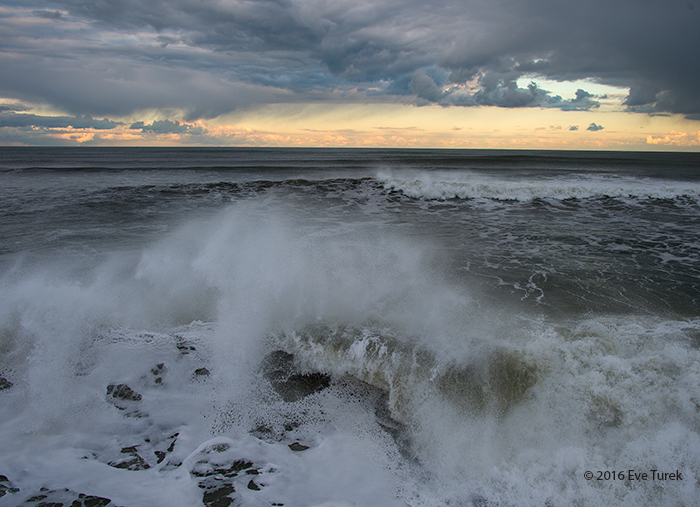
I love a west wind, particularly after a nor'easter. The seas typically run high for at least a day or two following a blow, sometimes longer, and when the wind shifts the ocean is to me its most dramatic. We've had west winds and high seas for a couple days now on the Outer Banks, and yesterday afternoon, I walked out on Kitty Hawk Pier near sunset. One of those images is below.


This last image is from this morning, shortly after sunrise.  Here, the story included a new set of characters--gulls who repeatedly flew into and around the wave splashes. No one was attempting to catch any fish for breakfast. In the spirit of Jonathan Livingston, these gulls seemed to be enjoying the morning cacophony of waves with as much glee as I, for sheer joy.

Wednesday, February 3, 2016

Weather or not...

 Ah, Punxsutawney Phil! I imagine you are a hero today to lots of folks who remember last year's record-breaking cold and snow, and who are already tired of being housebound by recent deep snows and ice in the northeast.  Early spring...six more weeks of winter...one thing is for certain: Groundhog Day lends a little magic, a little excitement in the middle of a season that is often long, cold, dark and difficult for lots of folks. What's not to like about the thought of an early spring?

Here on the Outer Banks, longtime locals have a saying: if you don't like the weather, just wait an hour or two; it'll change.

December boasted record-setting warm days. My little front yard crab-apple tree, which had already come through fall and shed its leaves, quickly put out a new green leafy crop, complete with tiny apples. Frost and thin ice followed for New Year's Eve, reddening the apples in what must have seemed to the tree to be the shortest summer ever.


A scant 30 days later, and the tree was in full autumn, its leaves an out-of-season golden. January rocked between overnight lows in the upper 20s and highs in the 70s.


Now the leaves are falling again, and I wonder, what will the little tree do when spring comes in earnest? I'm betting it somehow finds the strength to go through its seasonal cycle all over again, hopefully in a more timely and leisurely fashion than its recent ready-set-go, cramming a year's worth of living in the past six weeks.

My crab apple's saga reminds me how resilient nature manages to be, how hopeful. The air turned warm, and my apple tree responded because, as the Geico commercial reminds us, that's what apple trees do. They grow apples.


Seeing its response, I couldn't help but reach for my camera because I am a photographer. Clicking the shutter is what I do. One gift photographers receive is the celebration and remembrance of moments that might otherwise pass unnoticed. Years from now these images will be visual reminders of the summer-in-winter the Outer Banks enjoyed back in 2015/16, even if briefly. Even if it snows tomorrow. Whether we have six more weeks of winter, or are graced with an early spring, what was important in January shines through these reminders: nature's resilience, nature's hope.

Monday, January 25, 2016

Many Waves Breaking...

If I have a theme of "Lone Wave, Breaking" then this image is the outlier.

With winds blowing half-a-gale, the mercury stuck in the lower half of the 30's, I walked out on Jennette's Pier, grateful for the perspective an open pier in winter provides of the swath of storm-driven surf. Sometimes you have to bundle up and just go. This was one of those times.

Winter Storm Jonas waves, from Jennette's Pier.

Wednesday, January 13, 2016

Thematic Inspiration

Ah, January! Whether you formulate resolutions, wishes, intentions or goals, January is a time for setting our compass for the forward-looking journey. Sometimes we look back in order to peer ahead, to course-correct, or set off on a new direction entirely. One goal for me this January that teased at the edge of my thought like a kitten batting at a frayed rug was to resurrect this blog, abandoned last year when my husband had an unexpected health challenge that demanded focus and time. Something had to yield, and this newest blog became a casualty.

2016 promises to be even busier than 2015, so why would I attempt to run two blogs?

My vision for Everything Clicks has never changed: to see and share visual inspiration in the daily. Rather than posting once or twice a month with ten gleaned images and a longer nature essay as I do over on www.obxconnection.com/blogs/eve-turek.aspx, I designed this blog to be simpler. My goal here was and is to share one or two images around a theme, whatever occurred to me in the moment I clicked the shutter, or that revealed itself as I reviewed the images for processing.

I realized after I'd processed this image, from a beautiful warm January afternoon with clean swell, west winds, and magnificent late light, that I am still drawn to photograph what I call "lone wave breaking," a motif I've illustrated and written about for several years now.

So here is the latest offering in the Lone Wave, Breaking series.

Friday, February 27, 2015

In the Pink...

Google informs me that the phrase "in the pink" means in perfect condition, and is used especially of health.  I like the cliche for its implications.  "In the pink" is certainly apt description for how I feel when I can get outside.  Sometimes I am drawn to particular places; always I am alert to the presence of wildlife--the winged ones, the four-footed, even insects. I like the feel of wind on my face and I like the still, meditative feeling of the very air holding its breath when the breeze abates. No matter what's the matter, I always find solace, strength, serenity, whatever I need in the outdoors.


Afterglow

Lately, I've been drawn to pink. And yellow. I'm not imagining the pretty pastel wardrobes of spring gardens, though with another colder-than-usual winter I am not adverse to that idea! Rather I am seeing shades of pinks and yellows as backdrops to something else, different hues where I usually see blues or grays. The more I think about these shades, the more they seem to appear. The other afternoon as I was driving home from a wonderful encounter with my first ever Snow Bunting, thanks to the generosity of fellow photographer and birder Jeff Lewis who called to tell me where it was, I had pink on my mind.


Snow Bunting, Bodie Island


By the time I reached the road into my little island home, the sun set, turning sky and sound into a glorious wash of pink. I stopped at a small public access and photographed some Canada Geese floating in what looked like hot pink and purple ribbons.


Last month I watched a group of Snow Geese take wing into paler pink skies.


All of these outings and sightings definitely help me stay "in the pink." Hopefully you will feel the same way.


Tuesday, February 10, 2015

On Reflection...

For the past month, members of the Outer Banks region of the Carolinas Nature Photographers Association (CNPA) have focused on "Reflections" as our monthly theme. As I write this blog, the cold northeast wind is gusting over 40 mph, driving rain sideways. The Outer Banks is noted for nearly constant winds--that's the main reason the Wright Brothers came here from Ohio to test their gliders in preparation for the first powered flight on December 17, 1903. Ranging from light breezes to strong gusty gales, Outer Banks air is seldom still. That makes mirror reflections more of a challenge here than in areas with calm, clear lakes or slow-flowing rivers.

I find maintaining a still, calm, reflective heart is as much of a challenge as photographing mirror-like reflections. I think I reflect my best self, the self that is most connected both to the world around me and to God, in those moments. Sometimes they are literally moments, heartbeats and breaths in the midst of a busier, fast-paced day.


This reflection is precious to me since Pete and I were riding on a jet boat tour of the Colorado River. Most of the ride created a wake that rippled the water into waves and distorted reflections. At certain river bends, my view ahead gave brief moments of stillness. This is one of those.


This particular reflection taught me that even an inch of rainwater can act as a mirror, if the angle and light are right. Bodie Island Light, 2006, after a winter rain. I'd gone to search for egrets but the rainwater puddles provided the best view of the day. My larger lesson here is that sometimes calm comes as a gift even when I am focused anywhere but.

Sometimes wind can be an advantage, inviting the viewer into a fantasy world instead of mirroring reality. I created When Trees Dream in December, 2007 on the north end of Roanoke Island. Sometimes I use my meditative moments to imagine beauty and find gratitude even in the midst of life's storms.


Finally, here is one of the images I shared with our photo group last night: a group of Northern Shovelers resting on a rare windless, cold winter morning at Pea Island in January 2015. I find that my spirit as well as my eye rests in reflecting imagery and the sense of quiet such photographs imply.


Sunday, February 1, 2015

Early Spring? Not until Osprey arrive.

Sometimes we have seasons in our lives when themes seem to repeat themselves, over and over. I find this true with photography, too. I need to pay attention when certain motifs show up time and again. I've learned to be more aware when this happens with particular birds or critters, and ask for the greater lesson in the appearances. I find that each one always brings its own gifts. I recently made a new friend for whom Osprey and Red-tailed Hawks are messengers. I love them both myself but am especially alert these days for woodpeckers(especially Pileateds) and Crows. Both of those came calling at key moments this week for me. In neither case did I make a photograph--the moment was auditory more than visual. Over the years I have had the chance to photograph both, and to photograph hawks and Osprey as well. For my new friend, here are some of my favorite Osprey moments.


Osprey mate for life and the male is involved in every aspect of raising baby osprey to adulthood, including helping build or repair the nest, incubating eggs, and feeding the female and baby osprey. 

I've witnessed all of these behaviors over the years.


Fishing at dawn.

The cycle begins again. This pair, in the Colington Harbour marina, has been together for at least the past 18 springs. We always keep close watch in late February/early March for their arrival. They don't spend the winter together in the same place, and have a staggered schedule of return so I am always grateful when both come safely home.


I call this "Chip off the block." This is the papa osprey and one of the offspring. Baby Osprey have orange eyes. 


Tuesday, January 27, 2015

Unexpected Gifts

I read about photographers who approach their photography as a successful CEO might prepare for a meeting of the company board of directors: plan the work and work the plan. I understand and admire the strategy; photography doesn't seem to work that way for me. It's not that I don't think ahead of time or go to a location with a pre-determined subject or point of view. More often than not, I am surprised by what or who I find. I practice pre-visualizing only to find other gifts await. Mindful photography for me means more than using my mind to learn my gear or learn about the natural rhythms of the places and critters I love to photograph--although I do all that to try to be prepared when I go. Mindful photography means having an open mind and heart to respond to the moment as it is. I often find myself longing for more time to photograph, wishing I had hours to spend in a given spot, or the chance to revisit sites day after day to learn even more about who comes where, when. My life--as I suspect is true of many of you--includes what I've come to call touch-and-go photography. I squeeze in precious minutes around necessary tasks. I let those minutes touch my heart and I go back into the daily refreshed and inspired.

Here are three of my favorite gifts I never saw coming.


After a late fall nor'easter, I went to the beach, intent on the wrack line, a treasure trove of whelk egg cases, skate cases, broken shells, small driftwood fragments. I kept my eyes downward toward my feet when a persistent impulse insisted: look UP! I finally listened, looked, and received this "Sky Smile" -- an upside-down rainbow directly overhead. Seconds later it was gone. 


This is also an "after-the-storm" image. I'd hired a pilot so I could photograph the Currituck Light from the air.  As we flew north I noticed huge clumps of sea foam, one of which looked like a misshapen heart. As I watched and photographed, the heart came into perfect form. Seconds later, the shape changed. By the time we reached the lighthouse, the sun's angle made the photograph I'd originally envisioned impossible. I'm convinced I was in the air that day to receive--and share--this greater gift. 


In January 2013 a group of local nature photographers made our annual trek to Lake Mattamuskeet. This would be my first time at the lake before dawn. I imagined vibrant winter skies, glowing oranges and pinks in sky and water. Instead, the day dawned with dense fog rather than golden morning light. The fog turned out to be the gift. The cypress trees, seemingly suspended in space, mesmerized me. I photographed them from different angles with different lenses at different times of the morning. A year later, this photograph would win the Gold Medal for landscape photography in the inaugural World Photographic Cup: definitely a gift I never saw coming!


Wednesday, January 14, 2015

Cabin Fever

Lately I, along with many artist and photographer friends, am suffering a long case of Cabin Fever. And it’s only January!  We’re not snowed in or iced in, as are our neighbors to the north and west. We’re grayed-in and rained-in and therefore somewhat reined in (pun intended).

Funny term, cabin fever. When I think of “cabin” I immediately free associate woods and wood, cozy, warm, inviting, blanket, fireplace and mountains.  Those are all exciting and comforting words for me. Some readers may instead conjure sand, relaxing, colorful, beach towel and ocean.


For whatever form your Cabin Fever takes, I offer up these treasured moments and memories.


Cabin Rockers, North Rim, Grand Canyon


Western North Carolina


Old Cape Cod


Hatteras Village, NC